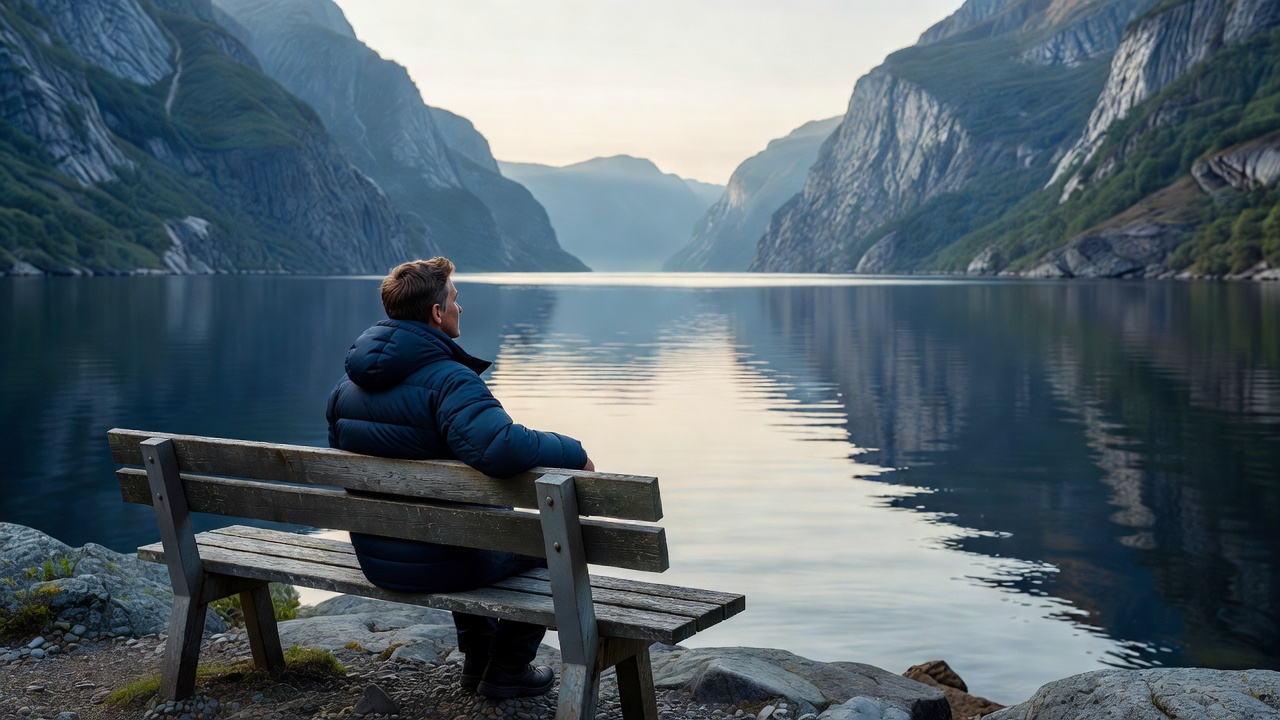
Travel writing often asks a landscape to do too much: restore us, change us or make us feel immediately calm. Real days are less predictable. You may arrive tired, distracted, cold or still thinking about work. None of that means you have missed the point of being there. A fjord is a place, not a treatment or a test of your ability to relax.
The suggestions here are small ways to spend time, not clinical exercises. Use what feels comfortable and leave the rest. If deliberate attention makes you uneasy, you can talk to a companion, read something familiar or return indoors. There is no requirement to sit with discomfort for the sake of an imagined benefit.
Begin with comfort and a safe position
Choose a public place where stopping is permitted and where you are not obstructing a path. A bench set back from the water is often a better choice than wet rocks or a working quay. Keep clear of unguarded edges, boat operations and traffic. Quiet attention should not reduce your awareness of what is happening around you.
Add a layer before you become cold. If the seat is wet, standing comfortably or moving indoors may be better than persisting. Keep your eyes open if that feels easier, and breathe normally. You do not need a special posture, a timer or a particular kind of clothing.
Let one detail be enough
Rather than trying to absorb the whole view, notice something close and ordinary. It might be a rope shifting against a post, the sound of a small wave or a patch of light moving over a wall. Let the detail change without trying to hold it still. When your attention wanders, that is simply something attention does.
You might look across the water and notice different layers: the near shore, a passing boat and the opposite hillside. Or listen for a nearby sound and then a more distant one. There is no need to name everything or turn it into a list. Stop whenever you want, including after a single glance.
Walk without collecting evidence
A short familiar stretch can support this kind of noticing, provided the surface and conditions are suitable. Keep enough attention on your footing and surroundings. At a safe stopping point, pause to look rather than walking while absorbed in a phone screen or the view across the water.
Taking a photograph is not a failure of attention. If you want one, take it without entering private land, blocking others or approaching wildlife. Then decide whether you would like to put the phone away. A phone can also be a useful accessibility, navigation or connection tool; leaving it behind is not a measure of commitment.
Make room for company
Quiet time does not have to mean being alone. With a companion, agree that you do not need to fill every pause with conversation. You could each notice something and share it later, or talk about something entirely unrelated to the landscape. Companionship is allowed to remain ordinary.
A simple meal near the fjord can offer a natural stopping point. Choose somewhere comfortable and within your budget rather than seeking a perfect setting. Eat while the food is warm, notice what you enjoy and let conversation take its own shape. You do not need to describe the meal as a ritual for it to matter.
Let indoor time count
In rain, wind or fatigue, move the idea indoors. A window seat, a library visit where available, a café or your own room can provide somewhere to settle. Ask about opening hours and whether lingering is appropriate; a busy café table is also someone else's workplace. Buy only what you want and can afford.
Reading a few pages or listening to familiar music can be enough for the afternoon. So can doing nothing in particular. Avoid replacing a busy sightseeing plan with an equally demanding programme of journaling, breathing exercises and carefully scheduled rest. If an activity begins to feel like another task, simplify it.
Leave feelings ungraded
At the end of the day, you might ask a practical question: what made today easier, and what would I change tomorrow? Perhaps the answer is an earlier meal, a shorter walk or a warmer place to sit. You do not need to assess whether you became calmer, more mindful or more grateful.
Nature experiences can be enjoyable, neutral or difficult, and they do not replace healthcare or professional support. If you are travelling with ongoing health needs, make appropriate arrangements independently of these suggestions. Permission to do less includes permission to seek familiar support and to choose a different kind of day.